
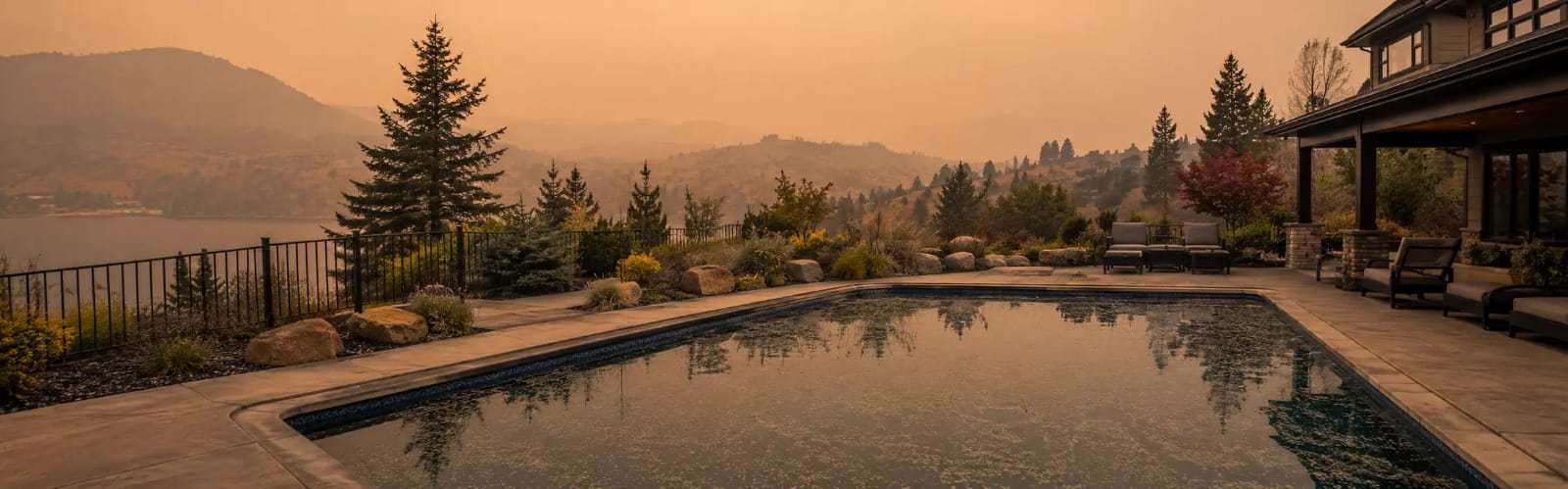
As wildfire activity continues to affect communities across British Columbia and Alberta, our hearts go out to everyone impacted throughout the Okanagan, Western Canada, and the Calgary region. Beyond the immediate safety concerns, the persistent smoky skies bring a unique challenge that many homeowners don’t anticipate: severe disruption to their outdoor pool water care.
Whether your pool is in Kelowna, Vernon, or Calgary, airborne ash, soot, and carbon debris are constantly settling onto your water’s surface, Even if your pool remains covered. These microscopic particulates carry heavy loads of organic contaminants, alkaline minerals, and high concentrations of orthophosphates. Left unmanaged, wildfire smoke can destroy your chemical balance in a matter of hours, driving up chlorine demand, spiking pH levels, clogging filters, and creating ideal conditions for rapid green algae blooms.
At Trevi Pools & Spas, our professional maintenance team continues to service client pools on their regular schedules. However, under heavy smoke conditions, weekly service visits are designed to complement(not replace) daily homeowner care. In this guide, we’ll break down the hidden science of how wildfire smoke alters your water chemistry and share a simple step-by-step action plan to help keep your pool safe, clear, and balanced between our service visits.
🧪 The Science: What Happens to Your Water Chemistry During Smoky Skies?
When forest fires burn, they release massive clouds of airborne wood ash, carbon soot, and organic debris into the atmosphere. Understanding how these pollutants interact with pool water is the first step toward maintaining crystal-clear chemistry.
- Spiking pH Levels (Alkaline Ash Fallout): Airborne plant and wood ash contain high concentrations of carbon, calcium, and potassium carbonate. When ash lands in your pool, it acts as an alkaline base, driving your pH levels up rapidly.
- The Risk: Water with a pH above or drastically reduces chlorine’s sanitizing power, rendering your sanitizer up to 80% ineffective.
- Surging Chlorine Demand: Free chlorine works continuously to oxidize organic material. When soot and burnt debris rain down on your pool, free chlorine is consumed almost instantly, driving sanitizer levels down to zero in a single afternoon.
- Elevated Phosphate Levels: Wood smoke is rich in orthophosphates, which are the primary food source for algae. High phosphate levels combined with depleted chlorine create the perfect storm for sudden green algae outbreaks.
- Rapid Filter Clogging: Microscopic carbon soot and fine ash pass through skimmer baskets and coat filter media. Filter pressure (PSI) can rise quickly, leading to reduced circulation flow if filters aren’t cleaned frequently.
🛠️ Homeowner Action Plan: 6 Essential Steps Between Service Visits
Our maintenance program is designed to partner with your regular pool care routine. During periods of heavy atmospheric debris and wildfire smoke, taking these proactive daily steps between service visits will protect your equipment and keep your water safe:
- Empty Skimmer & Pump Baskets Frequently: Clear leaves, ash, and floating debris before they sink. Safety Note: Always turn off the pump motor before opening and clearing the pump basket.
- Skim & Brush Water Surfaces Regularly: Use a fine-mesh skim net to collect floating soot and ash daily. Brush the pool walls and floor to prevent settling soot from staining vinyl liners or plaster finishes.
- Extend Daily Circulation Times: Run your pool circulation and filtration system longer each day. Continuous circulation keeps water moving through the filter, trapping fine soot particles before they settle.
- Monitor Filter Pressure & Clean Filter Media: Keep a close eye on your pressure gauge. Backwash sand filters or rinse cartridge filters as soon as pressure climbs 8–10 PSI above normal operating baseline.
- Dose Specialty Water Care Chemicals:
- Phosphate Removers: Apply a phosphate remover to eliminate algae nutrients introduced by falling ash.
- Enzymes & Clarifiers: Use pool enzymes to break down non-living organic carbon and clarifiers to clump microscopic soot for easier filtration.
- Preventative Algaecide: Dose weekly with a quality algaecide to add a protective layer against algae blooms.
- Test & Adjust Water Chemistry Daily: Test sanitizer levels and pH frequently between scheduled maintenance visits. Keep your pH balanced between 7.2–7.6 and maintain Free Chlorine elevated between 3.0–5.0 ppm during active smoke events.
Free In-Store Computerized Water Lab Testing
If your pool water becomes difficult to balance, cloudy, or excessively dirty during heavy wildfire smoke conditions, don’t guess—bring a sample in for a professional diagnosis.
At both our Kelowna and Calgary showrooms, Trevi Pools & Spas offers Free Computerized Water Lab Testing. Simply bring a fresh water sample in a clean container to our water care station. Our local specialists will run a comprehensive analysis and hand you a step-by-step chemical treatment blueprint tailored specifically to your pool.
| Symptom / Observed Issue | Underlying Cause | Corrective Action |
|---|---|---|
| Rapidly Dropping Chlorine | High organic load & soot consuming sanitizer | Shock pool with unstabilized chlorine & maintain 3–5 ppm |
| Rising pH (> 7.8) | Alkaline wood ash & carbon fallout | Add pH Decreaser (dry acid) daily to restore chlorine power |
| Dull, Cloudy, or Hazy Water | Fine suspended airborne soot particulates | Add enzyme treatment/clarifier & run filtration continuously |
| Sudden Green Algae Bloom | High orthophosphate spike from wood ash | Dose with commercial Phosphate Remover & shock water |
| Low Return Flow / High PSI | Soot & debris buildup inside filter media | Backwash sand filter or chemical-soak cartridge filters |
📍 Visit Your Local Trevi Showroom Today
If your pool develops severe algae, becomes excessively dirty, or if you would like to schedule an extra maintenance visit, our expert team is here to help get your pool back into top condition.
- Trevi Kelowna Showroom:
- Address: #3 – 151 Adams Road, Kelowna, BC
- Hours: Monday – Saturday | 9:00 AM – 4:00 PM
